
'The risk is in not being invested and missing out on an upmove.'

Narendra Modi is India's most successful prime minister and the greatest global leader of current generation, billionaire Mukesh Ambani said on Wednesday as he flaunted his group Reliance Industries' Gujarati heritage and its over USD 150 billion (Rs 12 lakh crore) investment in last 10 years.

'Being one of the 150 million upper middle class consumers, I can vouch that the average expenses on white goods or clothing are minimal. Indians are not consumerist by nature,' says Colonel Anil A Athale (retd).

Global funds, according to Christopher Wood, global head of equity strategy at Jefferies, are now beginning to pay more attention to India with the market now offering 30 companies with a market capitalisation over $25 billion.

A change in the desire to buy consumer durables is perhaps the most important indicator of an economy changing direction, explains Mahesh Vyas.

'...which is possible through flexicap and multicap funds.' 'The latter has a better balance between large, mid and smallcap stocks.'
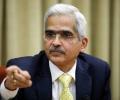
RBI governor Das flags growth slowdown, deputy raises alarm on inflation

'Election funding needs a little more transparency.'

Economy to grow 6.5% in 2016 on better macro conditions, says Mckinsey.

India, the world's third-largest energy consumer, will see its energy needs doubling by the end of this decade as it witnesses an unprecedented explosion of economic growth, the nation's richest man Mukesh Ambani said on Saturday. Speaking at the convocation of Pandit Deendayal Energy University (PDEU), Ambani, who heads the nation's most valuable company Reliance Industries Ltd, said the Indian economy will become a $40 trillion economy by 2047 from the current $3.5 trillion. "And to fuel this growth, the country will need enormous amounts of energy - clean, green energy that won't choke mother nature for the sake of human progress," he said.

The Indian economy was on an impressive growth path through the first decade of this century till it was brought to an abrupt halt by the policy inertia during UPA2 and the Modi government's inability to restore economic and financial momentum. Fascinating glimpses of what went wrong from Puja Mehra's must-read book The Lost Decade: How India's Growth Story Devolved Into Growth Without A Story.

'Should the government be in the business of running banks?' 'Particularly when it does not have the fiscal strength to continuously infuse capital into such banks?'

'India is an equity market with a breadth and depth of companies to invest in.'

The longer it takes for RBI and the government to stabilise monetary conditions in the economy, the more severe and long lasting will be the damage caused to various sectors of the economy, especially to the informal sector, says Rajeswari Sengupta. Rajeswari Sengupta discusses the impact of this move on money supply, output and prices, in the short- and medium-term.

Tata Steel, Tech Mahindra, NTPC, JSW Steel, Power Grid, UltraTech Cement, HCL Technologies and HDFC Bank were among the major gainers. Bharti Airtel, Hindustan Unilever, Axis Bank, Reliance Industries, Kotak Mahindra Bank, ICICI Bank and IndusInd Bank were among the laggards.
'The biggest risk to the Indian markets from a 12-18-month view is that the current government does not get re-elected, or loses in a way that is not represented at all in the next central government.'

We still have time for this government to take action.
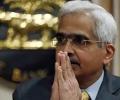
Reserve Bank Governor Shaktikanta Das on Friday stressed that the monetary policy must remain actively disinflationary to ensure that the decline in inflation from its peak of 7.44 per cent in July continues smoothly. Addressing the Kautilya Economic Conclave 2023, he also said price stability and financial stability complement each other and it has been an endeavour at RBI to manage both efficiently. Retail inflation declined to a three-month low of 5.02 per cent annually in September on account of moderation in vegetables and fuel prices, and was back within the Reserve Bank's comfort level.

India will not tailor its policies to suit US EV maker Tesla, and its laws and tariff rules will be formulated to attract all-electric vehicle manufacturers from across the world to set up a base in the world's fastest-growing economy, Commerce and Industry Minister Piyush Goyal said. Tesla has been seeking an initial tariff concession that would allow it to offset 70 per cent customs duty for cars priced less than $40,000, and 100 per cent for cars of higher value.

'In India, the GenAI startup ecosystem is unfolding with remarkable speed, signalling a new era of technological advancement and investment opportunities.'

'All imaginary figures are pushed by government bureaucrats.' 'They never showed that the production of wheat was less this time.'

The slowdown in corporate revenue growth over the last one year has begun to reflect in India Inc's capital expenditure, or capex. The country's top listed companies are going slow on fresh investment in capacity expansion, in line with a deceleration in their top line growth. The combined fixed assets of the listed companies, excluding banking, finance services and insurance (BFSI) and the government-owned oil & gas firms, were up 10.1 per cent year-on-year (Y-o-Y) during April-September 2023 (H1FY24) - the slowest in 18 months - as against 21.1 per cent Y-o-Y growth in H2FY23 (October 2022-March 2023) and 11.6 per cent growth in the April-September 2022 period (H1FY23).

'Interim Budget has ignited the entrepreneurial spirit.'

The five policy missteps that have led India to economic crisis.
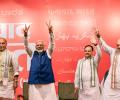
'Commentators have said that dealing with allies as equals will make Modi more sensitive.' 'Remember that the people Modi is dealing with are equally autocratic in their own lairs.' 'Further, Modi always has handy the threat of dissolving Parliament and calling for fresh polls.' 'Most of his own party, and certainly his allies and opponents having blown their budgets of efforts and resources in the just concluded elections, have no stomach for this.' 'They are all greatly looking forward to the loaves and fishes of office on offer.' 'That gives Modi an unbeatable advantage in any push-comes-to-shove situation,' explains Shreekant Sambrani.

'Although mid- and small-cap funds have the potential for higher growth, they come with inherent higher volatility.'

Geopolitical headwinds leading to lower demand from export markets, coupled with lower domestic buying, have dragged the auction average of Darjeeling tea to its lowest level since 2015. Data from Calcutta Tea Traders Association (CTTA) shows that the average price of Darjeeling tea at Kolkata auctions for January-December 2023 was Rs 319.74 per kg. The last time it dipped below this level was in 2015 at Rs 285.71 per kg.

Nearly a third of an average Indian citizen's consumption budget is spent on food.

'Even where we are now today, the growth rates are very good, but we need to get to 8-9 per cent growth in the years to come.'

Banks are pushing into credit cards and personal loans, using blanket advertising, cold call campaigns and even sending employees to malls to lure customers.
The dip in industrial production has been described as not a cause for worry as this figure is based against the high growth of 14.8 per cent in March last year.
Rupee depreciation to cut earnings 3-4 per cent in FY14.

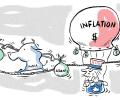
The spike in food prices at the onset of the monsoon season has corroborated the Reserve Bank of India's (RBI's) view that the fight against inflation is far from over, the State of the Economy report of the central bank said. At the same time, the report said that the country is poised to become the fastest-growing major economy in the world, notwithstanding some sequential moderation in economic activity in June. Consumer Price Index (CPI)-based inflation rate increased to 4.8 per cent in June 2023, from 4.3 per cent in May, primarily on account of an increase in food inflation.

An improvement in political relations, anchored in a restoration of peace and tranquillity at the border, could open up opportunities for expanded economic and commercial relations between them, suggests former foreign secretary Ambassador Shyam Saran.
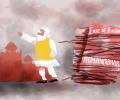
Indian growth in the rest of this fiscal year and next will be propelled by robust domestic consumption as consumer confidence improves, and by investment, including large increases in government capital expenditure, according to the Asian Development Outlook September 2023. "As slowing exports could foment headwinds for the economy, and erratic rainfall patterns are likely to undermine agricultural output, the growth forecast for FY2023 is revised down marginally to 6.3 per cent," ADB said.

'One of the biggest issues the Indian economy faces right now is of job creation...' 'The nexus between growth and employment has to be closed...' 'In the absence of a manufacturing expansion, the alternative is to have the service sector as the driver of both GDP as well as employment growth.'

'Investment creates capacity and reduces inflation. Income, employment, and savings rise.'

Reliance Industries Ltd on Friday reported a 27 per cent jump in its September quarter net profit as earnings from the oil and gas business rebounded, and a pick-up in fashion and grocery helped boost retail revenues. The oil-to-retail-to-telecom conglomerate's consolidated net profit of Rs 17,394 crore, or Rs 25.71 per share, in July-September - the second quarter of the current 2023-24 fiscal - was 27.3 per cent higher than Rs 13,656 crore, or Rs 19.92 a share, earning a year back, the company said in a statement. The net profit was also higher quarter-on-quarter compared to Rs 16,011 crore earnings in the preceding three months ended June 30.

India, along with Southeast Asian countries such as Indonesia, is expected to sustain growth in the medium-term in Asia region, replacing China as the key growth driver, Morgan Stanley and Nomura said in two separate reports released on Monday. While Morgan Stanley projected a 6.2 per cent gross domestic product (GDP) growth forecast for India in FY24, Nomura estimated the Indian economy to grow at 5.9 per cent in 2023. "Even with a slowing China, we expect GDP growth in Asia to sustainably outperform other emerging markets and the US. India and Southeast Asia are set to be the fastest-growing economies this decade.
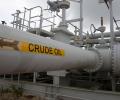
Indian imports of Russian oil plunged by a record in August month-on-month (M-o-M) as discounts on the fuel shrank in tandem with rising Brent oil prices. Higher crude prices will drive inflation or hurt earnings at oil companies and India's fiscal position if such spikes are not passed on to consumers. Indian purchases of Russian crude declined by around 24 per cent in August from July to the lowest level since January, with refiners expecting volumes to drop further amid rising rates of Russian benchmark Urals grade, substantial stocks at refiners, and planned maintenance at Indian refineries, according to ship tracking data and industry officials.
